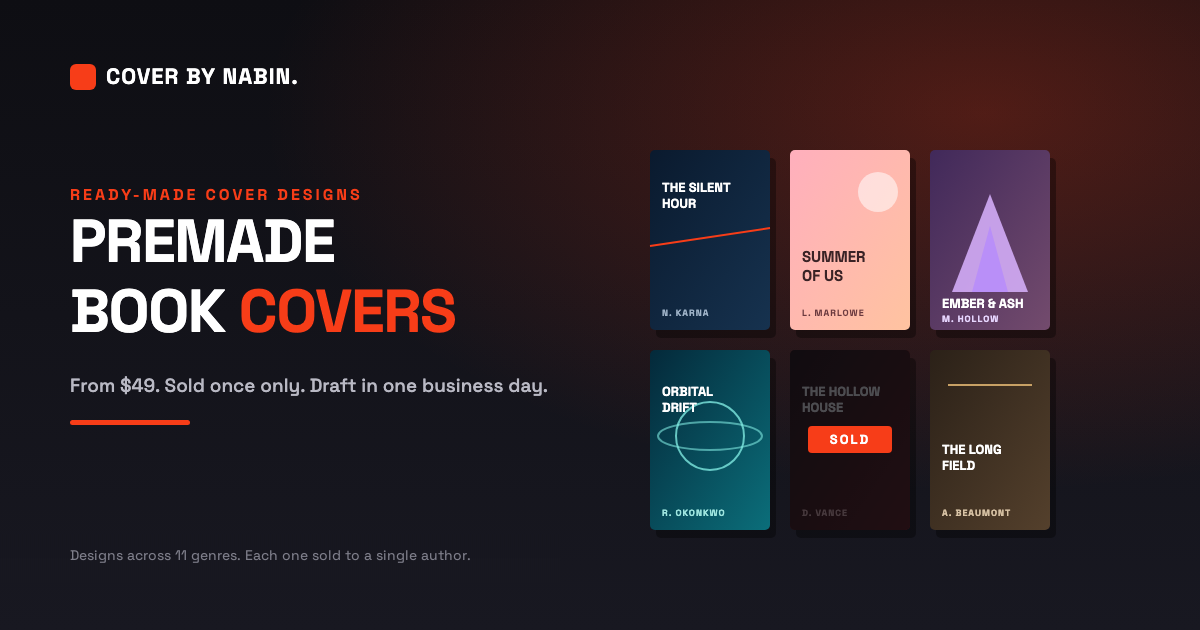
Most authors find their way to a premade cover for the same reason: the manuscript is finished, the launch date is set, and the cover still has to be made. A custom commission means weeks of briefing and concepts. A premade cover means the design already exists, and the only question left is whether it fits your book.
This page is the long version of that answer. I design the covers in the premade library, so everything here is how it actually works: the real prices, the real turnaround, what revisions cover, what lands in your inbox, and what happens to the artwork once you own it.
"A book cover isn't just art, it's a silent salesman." Every design in the library is built to do one job: make a stranger stop, in a list of twenty other covers, at thumbnail size.
What Is a Premade Book Cover?
A premade book cover is a finished design that already exists and is sold to one author only. You are not commissioning artwork from scratch, which is why it costs $49 rather than the price of a custom build, and why there is no wait for concepts.
What surprises authors is how little is actually given up. The design work is done, but everything after it still happens the way it would on a commission. The title and author name are set on the artwork. Colours and typography can be adjusted. The print formats are built to your printer's specification. And at the end you get the source file, not just a flat image.
The trade is simple and it runs one way: you give up the right to dictate the composition from nothing, and in return you pay roughly half of what a custom cover costs and you publish this week instead of next month. If the artwork in the library already says what your book says, that trade is a very good one.
How to read the library
Browse by genre first. A cover that looks beautiful but signals the wrong genre will hurt you more than a plainer cover that signals the right one. Readers scan for category long before they read your title.
Is a Premade Cover Just a Template?
No. A template is a blank layout that thousands of authors can pour their own title into, so the same design can end up on hundreds of books. A premade cover is a finished, one-off piece of artwork that is removed from the library the moment it sells, so exactly one book ever carries it.
The difference shows up in the artwork itself. A template has to stay generic, because it has to work for anyone. A premade cover was designed for a specific mood in a specific genre, with the composition and the typography built around that mood. That is why premade covers can hold their own next to covers that cost several times as much.
It also shows up in what you own. With a template you have a licence to use a layout, and you will never quite know how many other books look like yours. With a premade cover the artwork is gone from sale the day you buy it, and no other author can follow you onto that shelf.
Premade or Custom: Which One Do You Need?
Buy premade when the artwork already fits your book and you want to publish quickly. Commission custom when nothing in the library matches your story, or when your book needs a concept that does not exist yet.
| Premade | Custom | |
|---|---|---|
| Starting price | $49 for the ebook cover | From $99 |
| What you choose | A finished design from the library | A concept built from your brief |
| First draft | Within one business day | Within three business days |
| Exclusivity | Sold once, then removed from sale | Built only for you |
| Revisions | Unlimited, included | Unlimited, included |
| Best for | Publishing soon on a fixed budget | A story no existing design can carry |
If you are leaning custom, the custom cover design service walks through that side of the studio in the same detail.
What Premade Book Covers Cost
The ebook cover is $49. The paperback, hardback and audiobook versions are $39, $29 and $19 more, and all four formats together come to $136. There is no separate design fee and no hidden tier.
Front cover
Ebook
$49
Sized for Kindle, Apple Books and Kobo. This is the format every order starts with.
Full wrap
Paperback
+$39
Front, spine and back, print ready, built to your page count.
Case laminate
Hardback
+$29
Front, spine and back in the case laminate wrap your printer expects.
Audio
Audiobook
+$19
Square artwork sized for the audiobook storefront.
Tick all four and the whole set is $136. Most authors buy the ebook cover alone to start, then add print formats once the book is ready for paperback. You do not have to decide the print formats on day one.
The wider studio pricing, including formatting and publishing, is on the pricing page.
What Is Included in the Price
Every order includes unlimited revisions, alterations to fit your title and author name, and the source file. Nothing that makes a cover usable is held back behind a second payment.
- Unlimited revisions and alterations. Colour, typography and detail can be adjusted until the cover fits your book. There is no round limit to count.
- Your title and author name set on the artwork, whether you supply them in the cart or email them afterwards.
- The source file, so you are not left holding a flat image you can never adjust.
- Print formats built to your printer's specification when you buy them, including spine and back cover.
- Exclusivity. The artwork is removed from the library once you buy it and is never sold again.
What is not included is anything that belongs to a different service, such as interior formatting or publishing. Those are separate and priced separately on the pricing page.
How to Buy a Premade Cover, Step by Step
Pick the cover, tick the formats you need, add it to the cart and pay. Title and author name can go in the cart or arrive later by email, whichever suits you.
Pick your cover
Browse the whole library or narrow it by genre. Read the cover the way a reader will, at thumbnail size, and ask whether it signals your category. Every design is sold once, so if one is taken it is gone for good.
Choose your formats
The ebook cover is the starting point. Add paperback, hardback or audiobook if you need them. If you are not sure yet, start with the ebook cover and add print later.
Add it to your cart
Fill in the title and author name now, or leave them blank. If you have bought a print format, add your back cover blurb, because that is the text that gets typeset onto the back.
Pay when you are ready
Checkout runs through PayPal, and you can pay with a PayPal balance or a debit or credit card. The moment payment clears, the cover comes off the site and the work begins.
Nothing to prepare in advance
There is no brief to write and no form to fill in before you buy. If all you have is the cover you like and a title, that is enough to start.
How Fast You Get Your Cover
Your first draft arrives within one business day of payment. The design already exists, so there is no concept stage and no waiting to see whether the direction is right.
That is the whole reason premade covers exist. On a custom commission the slowest part is the beginning: briefing, concepts, choosing a direction. A premade cover skips all of it. You have already chosen the direction by choosing the artwork.
Payment clears
Your order and its details reach me, and a confirmation goes to your inbox.
Your cover leaves the site
It is exclusive to you, so it is removed from the library and will not be sold to anyone else.
First draft within one business day
You get the cover with your title and author name set, ready to look at. Then revisions run at whatever pace you need.
Revision rounds move at the speed of the conversation. Small changes turn around quickly, and because there is no round limit you are never watching a counter.
Revisions and What You Can Change
Revisions are unlimited and included with every order. Colour, typography and detail can all be adjusted until the cover fits your book, and there is no set number of rounds to spend.
In practice, changes cluster around three things: colour, typography, and detail. Those are the three levers that decide whether a design reads as your book or as a near miss, and they are the three I expect to move.
Colour
The palette carries the mood. A cover can be beautiful and still sit in the wrong emotional register for your book, so warming a palette up or cooling it down is often the single change that makes it click. Genre also has conventions worth respecting here, because readers read colour as a category signal before they read a single word.
Typography
Type is where a cover earns or loses its click. A title set in the wrong weight, or set too small to survive a thumbnail, undoes good artwork. This is also where a cover can be made specific rather than merely handsome: on one project the finishing touch was injecting the period into the lettering itself, which anchored the book to its setting in a way no colour change would have. You can see that reasoning in the case study for The Wall.
Detail
Small elements carry a lot: a tagline, a series line, a logo, an author photo, the removal of a distracting shape. Details are also where the print formats get finished, because the spine and the back cover need their own attention once the front is settled.
The fastest way to get what you want
Say what the cover is doing wrong, not what to do about it. "It reads as comedy, and the book is not a comedy" is more useful than "make it darker", because it tells me which signal to change rather than which knob to turn.
The Sold Once Promise
Each cover is sold once, then deleted from the library permanently. No other author can ever buy the same artwork, and that is the entire point of buying premade rather than using a template.
It is worth being concrete about what that prevents. The worst outcome for a premade cover is not that it looks cheap. It is that a reader recognises it on someone else's book, because that instantly tells them both books were assembled rather than made. Exclusivity removes that risk entirely.
There is a trade, and it is worth knowing before you browse. Once a cover is sold it is gone for good, so the design you hesitated over on Monday may not exist on Friday. If a cover fits your book, waiting is the only thing that can cost you it.
The other half of the promise is that the library is a studio, not a marketplace. Every design in it was made by the same designer you are buying from, which is why the covers are not competing with thousands of near-identical layouts uploaded by strangers. You can read more about the studio and the work behind it on the about page.
The Four Formats
You can buy the ebook cover alone, or add paperback, hardback and audiobook versions. Each format is built to the specification of the storefront it is sold on, rather than being a resized copy of the front cover.
- Ebook. The front cover, sized for Kindle, Apple Books and Kobo. This is the format every order starts with.
- Paperback. The full wrap: front, spine and back, print ready.
- Hardback. The case laminate wrap, front, spine and back.
- Audiobook. Artwork sized for the audiobook storefront, where the presentation is square rather than tall.
The ebook artwork is not an arbitrary size. Amazon's own cover image guidelines recommend 2,560 pixels tall by 1,600 wide at a minimum of 300 DPI, in RGB rather than CMYK, and they warn that covers with fewer than 500 pixels on the shortest side are not displayed on the website at all. A cover built to a smaller spec can end up invisible on the page it is meant to sell from.
What Print-Ready Really Means
Print-ready means the file matches your printer's specification exactly. For Amazon KDP that means at least 300 DPI, a bleed of 0.125 inches on every side, and a spine width calculated from your page count rather than guessed.
This is the part authors most often underestimate, because a print cover is not one image. It is a single continuous spread that includes the back cover, the spine and the front, and the spine width changes with the length of your book and the paper you print on. KDP's own paperback submission guidelines give the arithmetic: cover width is bleed plus back cover plus spine plus front cover plus bleed, and spine width is the page count multiplied by 0.002252 inches on white paper or 0.0025 inches on cream.
Two more details from the same guidelines are worth knowing. Spine text is only printed on books longer than 79 pages, so a short book will have a blank spine however good the artwork is. And anything you cannot afford to lose to the trim needs to sit at least 0.25 inches inside the outer edge.
You do not have to work any of this out yourself. If you want to see the numbers for your own book, the free cover template calculator works out the wrap dimensions from your trim size and page count.
KDP also places a barcode on the back cover automatically if you do not supply one, which is why the back cover is typeset with that space in mind.
How to Choose the Right Cover for Your Book
Match the cover to the shelf your book will sit on, not to your personal taste. Open the top twenty bestsellers in your category and look at what they have in common, then look for a design in the library that shares those signals.
The reason to work this way is that readers use covers to sort before they use them to choose. A cover that signals the wrong genre will lose the reader before your title is read, no matter how good the artwork is. The signals are usually obvious once you look for them: the palette, the typography, whether there is a figure on the cover, whether it is illustrated or photographic.
Then do the thumbnail test, because that is the size almost every reader will actually see. Shrink the cover to the size of an Amazon search result and check three things: can you read the title, does the genre still come through, and does it stand out against the covers next to it. If any of those fail at thumbnail size, they fail everywhere that matters.
The library is arranged so you can work this way. Browse the full catalogue, or go straight to a genre: romance, fantasy, thriller, science fiction, or non fiction.
If you want to see how a cover behaves at storefront size before you commit, the free thumbnail audit tool shows exactly that.
Three Mistakes That Cost Authors Money
Buying a cover that signals the wrong genre, judging it at full size instead of thumbnail, and leaving the print formats until after launch. Each one is avoidable, and each one is expensive to fix later.
1. Choosing a cover that signals the wrong genre
This is the most costly and the least obvious, because the cover can be genuinely beautiful and still be wrong. A literary cover on a thriller tells the reader it is slow. A romance cover on a dark fantasy tells them it is light. The fix costs nothing: check your category's bestsellers before you fall in love with a design.
2. Judging the cover at full size
On a large screen, in a full-width preview, almost everything looks good. Readers see a thumbnail. Details that are charming at full size become mud at 200 pixels wide, and a title that was elegant becomes unreadable. Always check the small version before you buy.
3. Leaving print formats until after launch
The paperback wrap depends on your final page count and paper choice, so it cannot be finished before the interior is. If you plan to sell print at all, decide that early enough to send the blurb and the page details, rather than discovering the need the week your paperback is meant to go live.
What Happens After You Pay
Your cover is taken off the site, your order details reach me, and your first draft follows within one business day. There is nothing to chase and no form waiting for you.
- A confirmation lands in your inbox with your order number on it.
- Your cover comes off the library, so nobody else can buy it.
- You get the first draft within one business day, with your title and author name set.
- Revisions run by email until you are happy, then the final files and the source file are sent over.
If you left the title or the author name blank, reply to the confirmation with them, along with anything else you want changed. If you bought a print format, send the back cover blurb in the same reply, because that is the text that gets typeset onto the back.
One thing worth repeating: because exclusivity is used up at purchase, the sale is final. What protects you instead is the revision policy. Revisions are unlimited and included, so a cover you are not happy with is a cover I keep working on rather than a cover you are stuck with.
Frequently Asked Questions
What is a premade book cover?
A premade book cover is a finished design that already exists and is sold to one author only. You are not commissioning artwork from scratch, so the price is $49 rather than the cost of a custom build, and there is no wait for concepts. You still get the full service: unlimited revisions, alterations to fit your title and author name, and the source file at the end.
Is it really sold only once?
Yes. When a premade cover is paid for it is removed from the library permanently, so no other author can ever use the same artwork. Exclusivity is the whole point of buying premade rather than using a template.
What is included in the price?
Every order includes unlimited revisions and alterations, plus the source file. The ebook cover is $49. The paperback, hardback and audiobook versions are $39, $29 and $19 more, and all four formats together come to $136.
Can I change the title or the author name on the cover?
Yes. Put the title and author name in the cart when you buy, or leave them blank and email them afterwards. Both are fine, and setting them is part of the service rather than an extra.
Can I change anything else on the cover?
Yes. Revisions and alterations are included with every order, so colour, typography and detail can all be adjusted to fit your book. You are not limited to a set number of rounds.
How long until I get my cover?
Your first draft arrives within one business day of payment. The design already exists, so there is no concept stage to wait through.
What files do I receive?
You receive the finished artwork in the formats you bought, plus the source file. Print formats are supplied as print-ready files built to your printer's specification, including the spine and the back cover.
Do I need to send anything after I pay?
Your title and author name if you did not enter them in the cart, and the back cover blurb if you bought a print format. Anything else you want changed can go in the same email.
Can I get a refund?
Because the cover is removed from the library the moment it is paid for, exclusivity is used up at purchase and the sale is final. What protects you instead is the revision policy: revisions are unlimited and included, so a cover you are not happy with is a cover I keep working on.
What if I want something completely custom?
That is the custom cover service, where the design is built around your brief from the start. Premade covers are the faster, lower cost route to the same standard of craft.
Where to go next
Find the Cover Your Book Deserves
Designs across 11 genres, from $49, each one sold once. Browse the library and see what is still available, or take the free tools for a spin first if you want to test a cover at storefront size before you buy.